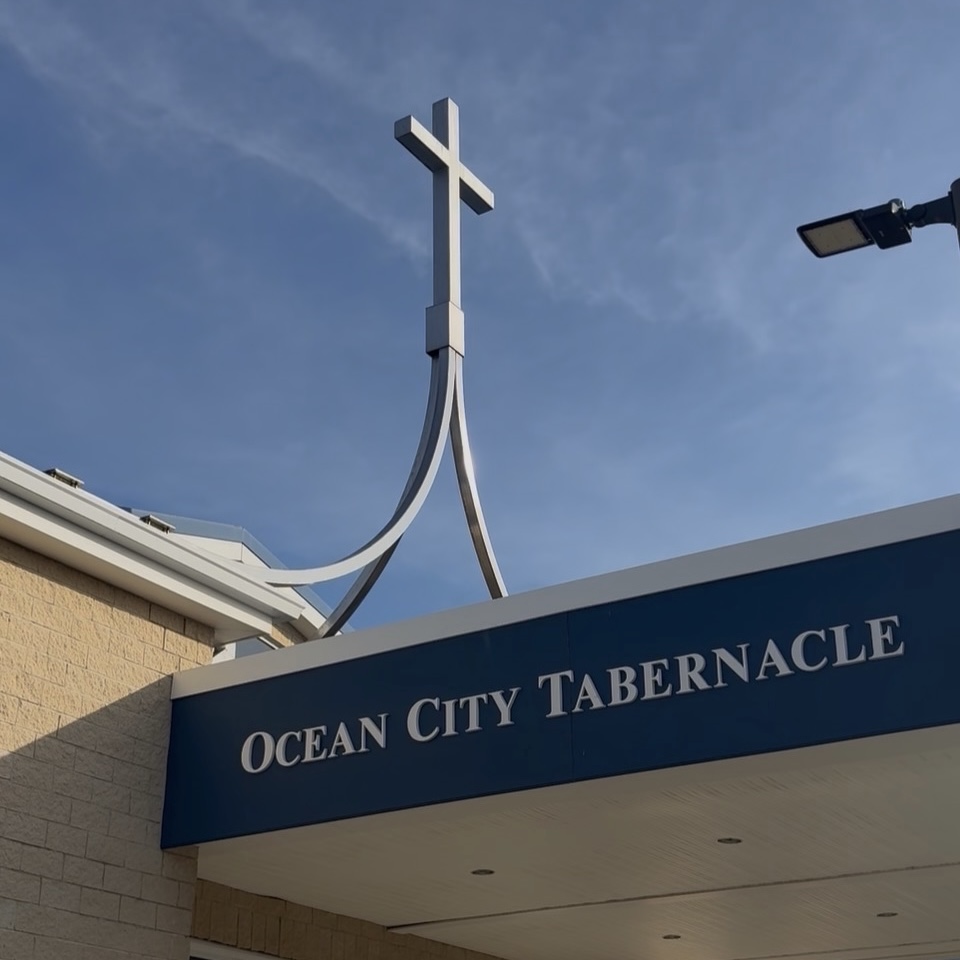
Pastor Rob Pacienza at Ocean City Tabernacle
Citizens of the City of God
Ocean City Tabernacle
Where Jesus Christ Is Central
Service Recap & Review
Service Details
- Speaker: Pastor Rob Pacienza
- Venue: Ocean City Tabernacle — 550 Wesley Ave, Ocean City, NJ 08226
- Date: Sunday, July 19, 2026 — 10:30 AM Contemporary Service
- Message Title: “Citizens of the City of God”
- SEO Keywords: Pastor Rob Pacienza · Ocean City Tabernacle · Ocean City NJ · Coral Ridge Presbyterian Church · Daniel chapter 1 · Citizens of the City of God · stand firm in culture · biblical worldview · Christian speaker New Jersey · 2026 summer speaker series · Ocean City Tabernacle YouTube · Babylon · how to stand firm
You Missed Something Extraordinary
Every era of the church has believed it was living through the worst of times. And every era has been both right and wrong about that.
Pastor Rob Pacienza opened his July 19th message at the Ocean City Tabernacle with exactly that observation — and then spent the next half hour proving that the story of a teenager named Daniel, exiled to Babylon 2,600 years ago, has more to say about our cultural moment than anything currently trending on social media.
The message was entitled Citizens of the City of God. It was built on Daniel 1:1-8. And it was the kind of preaching that doesn’t give you a seven-step plan or a comfortable reassurance — it gives you a spine. The full service is on the Ocean City Tabernacle YouTube channel. Watch it before you doom-scroll the news.
Who Is Pastor Rob Pacienza?
Pastor Rob Pacienza serves as Senior Pastor of Coral Ridge Presbyterian Church in Fort Lauderdale, Florida — one of the most storied pulpits in American evangelical history, founded by the late Dr. D. James Kennedy. He is a gifted preacher, a serious theologian, and a pastor who thinks carefully about how the church engages the culture without being absorbed by it.
He is also, in the best possible sense, one of us. His family represents four generations of Ocean City vacationers. He was born in Delaware County, raised in Chester County, and remains — his words — a lifelong Philadelphia sports fan. “To be a Philadelphia sports fan,” he told the room with a grin, “is a sanctifying experience.”
He arrived on July 19th having followed Brian Dawkins on the summer speaker lineup the week prior — a fact his fifteen-year-old son Preston apparently found more impressive than anything else on the résumé. What he brought to the Tabernacle stage, though, was a message as timely as the morning’s headlines and as old as the prophet Daniel.
The Long View — What Babylon Can Teach Us About Right Now
Pastor Pacienza opened with a gentle challenge to the assumption that we are living through uniquely dark days for the church. “I’ve often heard it said that it’s never been a worse time to be a Christian,” he said. “Well, I want you to ask the people of God living in the time of Daniel. I want you to think about the people of God living at the time of the birth of the early church — when it was illegal according to the Roman Empire to declare that Jesus Christ was Lord.”
The point wasn’t to minimize the present moment. It was to insist on taking the long view — and the long view leads directly to Daniel.
Daniel was a teenager. He was exiled from Jerusalem along with thousands of other young nobility and cultural leaders — not to destroy them, but to train them. Nebuchadnezzar’s strategy was deliberate: educate the best of Jerusalem’s youth to think, speak, and act like Babylonians, then send them back as cultural missionaries for Babylon.
“This is a timely message,” Pastor Pacienza said, “because it reminds us of what it looks like to live faithfully in a culture that is hostile to the people of God and to God himself.”
“We need to have a long view of the church, a long view of history. And the long view of history takes us back to stories like this — 2,600 years ago, a young man by the name of Daniel.”
The Mission of the City of Man: Three Marks That Never Change
Before turning to Daniel’s response, Pastor Pacienza argued that we need to understand what we’re up against. “If we are going to be good missionaries in the world but not of the world, we need to understand the mission of the hostile culture.” He identified three marks of the city of man in Babylon — and showed why each one has a direct modern counterpart.
The first mark is domination. Nebuchadnezzar didn’t just conquer Jerusalem — he took the sacred vessels from the temple of God and placed them in the treasury of his own gods back in Babylon. It was, Pastor Pacienza said, a trophy case. A statement to every Babylonian and every exile: “My god beat your God.” Nothing has changed. “Every time you turn on the news, every time you look through social media, it seems like the culture is winning. That’s why so many Christians back away and retreat in defeat.” The domination is designed to produce exactly that response.
The second mark is re-education. Nebuchadnezzar didn’t destroy Daniel and his peers — he enrolled them in a three-year curriculum in “the literature and the language of the Chaldeans.” He intended to replace the worldview they had been given in Jerusalem with the philosophy, values, and virtue system of Babylon. “We do it in four years when we send our children off to college,” Pastor Pacienza said plainly. No longer education — indoctrination.
The third mark is reorientation. Nebuchadnezzar gave Daniel and his three friends new names — names that no longer connected them to Yahweh but to the gods of Babylon. For the ancient world, a name was identity. Daniel means ‘God is my judge.’ His new name, Belteshazzar, honored a Babylonian deity. “Could you imagine a society,” Pastor Pacienza asked, “where the government redefines orientation and identity? Could you imagine a government that no longer allows you to be identified according to how God sees you, but how culture and society sees you?”
“The mission of the city of man is always one of domination, re-education, and complete reorientation — an entire takeover of the people of God. Nothing new under the sun.”
“But Daniel Resolved” — The Response of the City of God
After six verses documenting the calculated machinery of Babylon’s cultural program, verse eight arrives like a turning point. Pastor Pacienza lingered on it.
“But Daniel resolved.” The word resolved, he explained, describes an inner commitment — a steadfast decision to fulfill your calling regardless of the circumstances and regardless of the consequences. And Daniel knew the consequences were real. Refusing the king’s food and wine was not a small act of civil disobedience. It was a declaration.
Where did Daniel’s resolve come from? Not willpower. Not a personality type. Not raw courage. It came from a worldview — a foundation laid early, grounded entirely in the word of God.
“Daniel growing up as a citizen of the city of God was given a worldview that was not informed by the culture but instead informed by biblical truth. That’s what made him noble. That’s what gave him courage. That’s what gave him conviction.” He was immovable not because he was stronger than everyone else, but because he was rooted in something that couldn’t be shaken.
Pastor Pacienza was direct about the implication: “The great tragedy that we find ourselves in today is that we have once great churches and once great denominations founded upon the authority of God’s word that now are saying it’s no longer sufficient. And with the rise of liberal Christianity and progressive Christianity, you have pastors standing in pulpits watering down biblical truth and giving worldly philosophy as the answer for life.” His prayer was for a generation that would rise up and say: “Not on my watch.”
“I am immovable. I resolve to not defile myself. God’s word is sufficient for all of life in all places in all times. It was sufficient in the time of Daniel. It is sufficient today.”
The Greatest Force of Good on Earth
Before his closing illustration, Pastor Pacienza paused to push back on a narrative that too many Christians have quietly absorbed — that the church is a relic, a liability, or a source of harm in the world.
He cited a statistic: every year in America, 70 million people are served by the local church at a value of $20 billion. “For the young people in the room,” he said, “when you go off to college and people tell you that Christianity is either irrelevant or oppressive, you look them in the eye and you say: ‘No. In fact, Christianity has been and continues to be the greatest force of good on planet earth.'”
He quoted his friend Os Guinness: the West would be unrecognizable if it were not for the church. Early Christianity transformed the Roman Empire’s treatment of widows, orphans, and children — not through political power but through a biblical worldview lived out in community. That same power, he argued, is available now.
“We have 2,000 years of historical precedent of Christians running towards the darkness and not running away from it. That’s who we are. That’s who we’re called to be.”
“But If Not” — The Dunkirk Message
Pastor Pacienza closed with one of the most arresting illustrations of the summer at the Tabernacle — and it came from one of the darkest nights in modern history.
In the summer of 1940, the Nazi forces had the British army trapped between the English Channel and France. It was a desperate, dire situation. The British commander sent a message back to England — just three words: “But if not.”
At that time, eighty percent of England was biblically literate. The people knew exactly what those three words meant. They come from Daniel 3 — the moment Shadrach, Meshach, and Abednego were thrown into the fiery furnace for refusing to bow to Nebuchadnezzar. Their declaration: God will rescue us. But if not — we will still not bow.
The British commander was saying the same thing. God is for us. God is with us. God will rescue us. But if not — we will never bow the knee to the Nazis. That night, against all odds, the boats came. The troops were rescued. The miracle of Dunkirk became one of the turning points of the war.
“But I want to ask you a question this morning,” Pastor Pacienza said, quieting the room. “Who here today, in the face of cultural opposition in a hostile culture, will say, ‘But if not — the Lord is for me, the Lord is with me — I will never bow the knee to the idols of this culture’?”
“But if not — we will never bow the knee to the idols of this culture. That is your challenge and that is our calling.”
One Greater Than Daniel
Pastor Pacienza ended where every good sermon ends — not with a strategy or a to-do list, but with a person.
Daniel resolved because he was looking forward in faith to one greater than himself. Six hundred years after Daniel, into a world still under imperial domination — now Roman rather than Babylonian — God sent not a conquering war hero but a suffering servant. Jesus Christ, pure, holy, and blameless, took on our sin. He took the sword so that we would never have to fear it.
“If you are here today and you know Jesus Christ as your Lord and Savior, you have nothing to fear,” he said. “It’s Jesus Christ and Jesus Christ alone — the one that Daniel looked forward to — that gives us power and courage and confidence to live and exist and thrive in a hostile culture.”
And for those who hadn’t yet surrendered their lives to Christ: “The Bible says that today is the day of salvation. Not tonight, not tomorrow, because tonight and tomorrow is not guaranteed.”
“It’s not in your power, but it’s the power of Christ and Christ alone that gives you the confidence and the courage to exist as people of the city of God in the midst of the city of man.”
A Closing Word — and a Room That Responded
Pastor Pacienza closed with a prayer that was as much a charge as a petition: “Would you raise up the next generation of Daniels that resolve in their heart to not defile themselves? Lord, this is the hope for the world. This is the hope for our culture. This is the hope for our nation — that we would be men and women who go out to live in the world but not of the world.”
It was a morning that landed with particular weight coming off the July 4th weekend energy of Dr. Ben Carson’s message the week prior. Carson called for courage in the public square. Pacienza gave that call its theological foundation — reminding the room that courage without roots is just adrenaline, and that the roots Daniel had are available to every person in every pew.
The church has survived Babylon before. It has survived Rome. It has survived every empire that has ever tried to re-educate, reorient, and dominate the people of God. And the reason, Pastor Pacienza made clear, is not the church’s strength. It is the strength of the one the church belongs to.
The full service is available now on the Ocean City Tabernacle YouTube channel. Share it with someone who needs to hear the word ‘resolved.’
Watch the Full Service — Ocean City Tabernacle on YouTube
If you missed Pastor Rob Pacienza’s message in person, the full service is available now on the Ocean City Tabernacle’s official YouTube channel. Watch it, share it, and come back next Sunday.
Watch Pastor Rob Pacienza: “Citizens of the City of God”
Subscribe — new messages all summer long
Ocean City Tabernacle • 550 Wesley Ave, Ocean City, NJ 08226 • octabernacle.org
A family ministry center where the Gospel of Jesus Christ is central — every Sunday, all summer long.
Partner With Us
Each season, the Tabernacle becomes a place where people gather to hear the Word of God, worship together, and be renewed in their faith. Your support helps make that possible—strengthening a ministry that proclaims the Gospel, invests in the next generation, and provides a place where residents and visitors alike can encounter truth, encouragement, and community. By partnering with the Tabernacle, you are helping ensure that this work continues with clarity, purpose, and lasting impact.