Abide: The Secret of Friendship with Jesus
You Missed Something Extraordinary
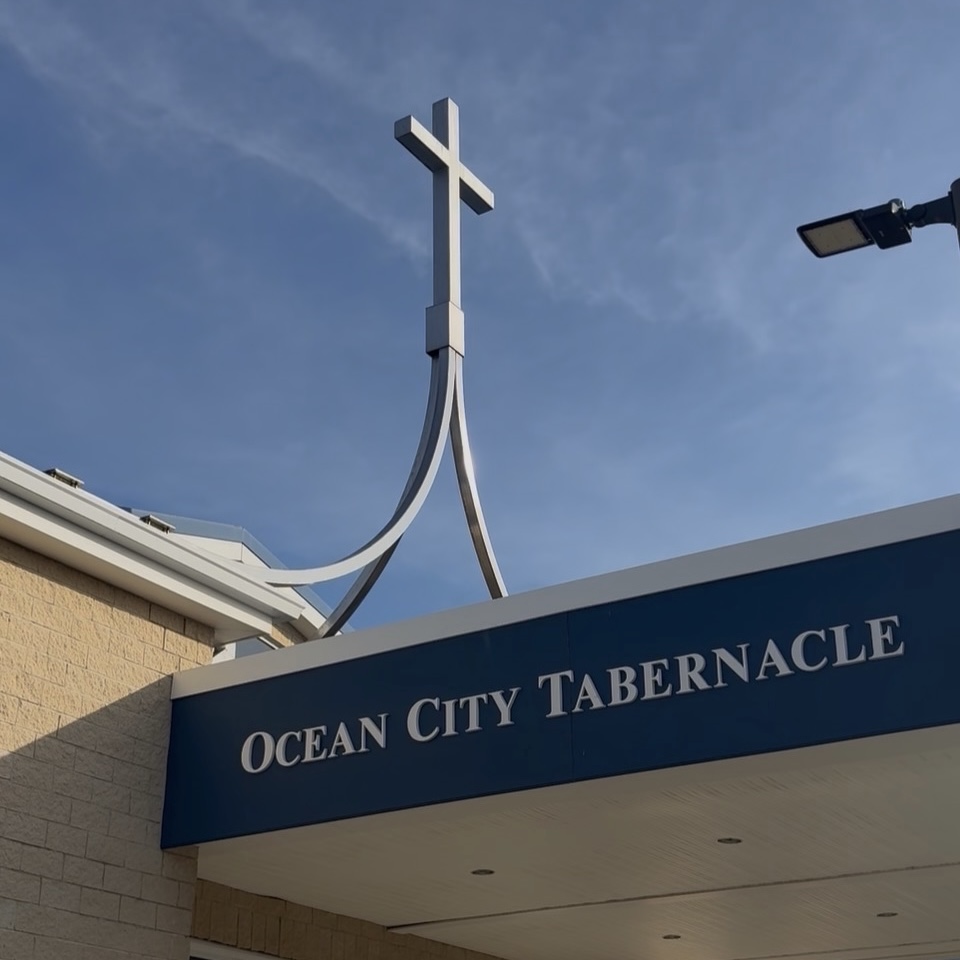
There are mornings at the Ocean City Tabernacle when a speaker opens the Bible and you realize that the thing they’re about to teach you is something they have personally lived from the inside out. August 16th was one of those mornings.
Ginny Owens — singer-songwriter, author of Singing in the Dark, and one of the most beloved voices in Christian music — brought a message from John 15 on what Jesus called abiding. She organized it around four questions: What does it mean to abide? Why should we? Why don’t we? And how can we?
The answers were theologically careful, personally honest, and occasionally hilarious. The full service is on the Ocean City Tabernacle YouTube channel. Watch it — and then come back for the evening concert she performed that same day.
Who Is Ginny Owens?
Ginny Owens is an award-winning singer-songwriter, author, and speaker who has been one of the most distinctive voices in Christian music for more than two decades. Named Gospel Music’s New Artist of the Year and the recipient of three Dove Awards, she has performed everywhere from the Sundance Film Festival to the White House to stages across Africa and South Africa. She served with the National Day of Prayer and is the author of Singing in the Dark, a book about finding faith through loss of sight.
Blind since the age of three and a half — when a surgery meant to stabilize her vision took all of it instead — Ginny has spent her life and career doing what her mother told her she had to do: learning to live it. She is based in New York City, where she has lived for nearly nine years.
She arrived at the Ocean City Tabernacle on August 16th for both a morning service and an evening concert — and brought the kind of message that doesn’t feel like a prepared talk so much as a conversation between friends.
Four Questions, a Vine, and a Secret God Wants to Tell You
Ginny Owens arrived at the Tabernacle on August 16th having made the trip up from New York City with a few friends — who, she noted with a grin, did not let her drive. She opened not with a song but with a verse she called one of her favorites: Psalm 25:14. “The friendship of the Lord is for those who fear him. To them he makes his covenant known.” In Hebrew, she explained, that last phrase reads more precisely: to them he tells his secrets.
“I want to think today about what it means to have that kind of a friendship with the Lord,” she said, “where he tells us the secrets of his heart. Sometimes we who have been in church for a long time are content thinking that Jesus has saved us for heaven. But what makes Christianity different from all other faiths is that we have a God who loved us so much that he made a way to welcome us into deep and personal friendship with him — from now until we see him face to face.”
She organized the morning around four questions from John 15: What does it mean to abide? Why should we abide in Jesus? Why don’t we? And how can we?
“The friendship of the Lord is for those who fear him. To them he tells his secrets. We are not just waiting for heaven. We are in vibrant friendship with him now.”
A Little Girl Who Went Back to Climb the Trees
Before diving into the text, Ginny shared the personal story that makes everything she teaches carry the weight it does.
Born and raised in the deep south, she lost her remaining vision at three and a half years old — after a surgery that was supposed to stabilize it took all of it instead. The surgery left her with no hope of recovering sight. But a few weeks later, she went back outside to ride her bike and climb trees. Her neighbors were so alarmed they once offered to call the fire department to get her out of a tree. Her mother’s response: “Nope. This is going to be her life. She has to learn to live it.”
The bigger challenge, she said, turned out not to be blindness but other people’s fear of it. In middle school, mean girls stole her lunch, called her names, held up fingers and asked how many. She started to believe every day of her life was going to be miserable.
“One afternoon after a very difficult day of lunch stealing and name calling, I went home praying I would never have to go to school again. My mom asked — because moms always have a sixth sense — and I couldn’t tell her because I was in middle school.” But she never forgot what her mother said anyway: “Jenny, Jesus is always your best friend. But some days he’ll be your only friend. And you can tell him everything — because he’s walked through the worst darkness for you.”
“As a middle schooler, I just wanted friends. I had professed faith when I was four at vacation bible school, but I didn’t really get how telling him everything could help me now. And how could I be okay with those days when he was actually my only friend? Most of all — how does Jesus facing the darkness of death change my life today?”
“Jesus is always your best friend. But some days he’ll be your only friend. And you can tell him everything — because he’s walked through the worst darkness for you.”
What Does It Mean to Abide? — We Are Always Branches
John uses the word “abide” or “remain” forty times in his Gospel and eleven times in this chapter alone. The Greek word carries the sense of a continual connection to a source — like a phone plugged into the wall. “Your phone abides in electricity,” Ginny said. “That’s the sense of abide.”
Jesus describes himself as the true vine and his disciples as the branches. A branch’s only hope is nourishment flowing from the vine. “Jesus is telling us here that you and I are always branches. We are never our own source. We are abiders. We must get our nourishment from outside ourselves.”
She pressed the congregation with three diagnostic questions: What gets the most airtime in your mind every day? What has the most power to make you content or anxious? Where do you get your sense of self and of purpose? “That thing or that person is your source, your vine.” As a middle schooler, hers was her peers. As an adult artist, it has sometimes been her career. “Whatever you are continually connecting to, deriving your purpose from — that is your source.”
“You and I are always branches. We are never our own source. We are abiders. We must get our nourishment from outside ourselves.”
Why Should We Abide? — The True Vine and the Orange Friend
Jesus doesn’t just call himself a vine — he calls himself the true vine. Ginny paused on that word. “The true version of anything is always the best version — the only version you want.” She compared it to baking: real butter, not margarine; real chocolate chips, not the imitation. “Jesus is the only source from which good will always come. Always.”
Then she offered a reframe of something the culture gets exactly backwards: “As abiders, we bear fruit. We don’t make fruit.” The source your heart is plugged into produces what comes out of you. She told the story of a friend who went on a carrot juice kick — a gallon a day — and walked into her doctor’s office to be greeted with a startled look. Her skin had turned orange. “If carrots are your primary source, you’re going to end up looking like a carrot. In the same way, whatever your life is centered on will be what you look like.”
The beautiful corollary: “If we get our purpose, our self-worth, our life from Jesus — the fruit will keep growing and growing, no matter what’s happening with our work or our friends or our kids.”
She illustrated with a friend who works with refugees, bringing them to dentist appointments, helping them navigate life in a new country. One Christmas, when her church was packing boxes to send overseas, the refugee children — who had almost nothing — saw what was happening and said: “You’ve done so much in our lives. We want to help the kids across the world, too. Can we raise money?” “Friends,” Ginny said quietly, “that is what fruit looks like.”
“As abiders, we bear fruit. We do not make fruit. The source your heart belongs to produces the fruit that comes out of you. You don’t change yourself — Christ living in you through his Holy Spirit is what changes you.”
The Gardener, Pruning, and the Princess Dress
God the Father, Ginny noted, is described as the gardener. “The God of the universe personally sees to our personal growth. He tends us. He nurtures us. He cultivates us.” And the reason he prunes is always to invigorate — to give life and energy to the plant. Pruned plants look rough at first, but grow fully over time, in the shape and direction the gardener had in mind.
“God’s pruning is only ever good.” She acknowledged the difficulty of that: pruning always involves suffering, and suffering is hard. But she leaned on Elisabeth Elliott: “God will never do anything to you that is not for you. His end goal is always to help you look like Jesus, the one living in you.”
Among the gifts of abiding, she named prayer, powerful witness, love — and then told a story about a white eyelet floor-length dress she called her princess dress as a little girl. A flower girl dress from her aunt’s wedding. She would put it on over her sweaty playground clothes and dance around the living room, asking her mom for tea. Until third grade, when she tried to zip it up and it simply wouldn’t close anymore.
“But friends, when you belong to Jesus, your royal days are never over. You never outgrow his robe of perfection. There’s not even a zipper. It just stays on. His beauty covers up all of your mess. His cross earned you a lasting place in his royal family.”
And finally: joy. She quoted a monk’s definition she loves: “Joy is the happiness that does not depend on what happens.” Her own version: “Joy is the inner smile that remains through trials. Joy says, ‘How crazy is it that I belong to the King of the universe? He lives in me and he’s growing fruit in me, even in the midst of our most difficult times.’”
“God will never do anything to you that is not for you. When you belong to Jesus, your royal days are never over. There’s not even a zipper. His robe of perfection just stays on.”
Why Don’t We Abide? — The Jesus-and Equation
Ginny was candid: “I do not abide as often as I want to. We forget every five seconds.” And she named the core reason: self-sufficiency.
“Especially in the US, we are strong. We are independent. We have a lot going for us. Even if you’re not super wealthy, you have food, a cell phone, and Amazon Prime. What more do you need? And most of us are really nice people and do some good things for our neighbors. So the more we have going for us, the more we forget how desperately we need Jesus. We think we’re doing pretty well on our own.”
This self-sufficiency often shows up in what she called the Jesus-and equation: “Jesus and my ability to do whatever. Jesus and my husband or my love for my husband. Jesus and my job.” We serve Jesus and something else. And it does not work.
She closed this section with C.S. Lewis: “There are two kinds of people in the end. Those who say to God, ‘Thy will be done.’ And those to whom God says, ‘In the end, thy will be done.’ But no soul that seriously and constantly desires joy will ever miss it.”
“The more we have going for us, the more we forget how desperately we need Jesus. We think we’re doing pretty well on our own. But Jesus tells us otherwise: apart from me, you can do nothing.”
How Can We Abide? — See, Savor, Sing
Three ways, all starting with S — which Ginny admitted was the organized part of her personality asserting itself.
First: See. See what it cost Jesus to say the words of John 15. He knew, even as he spoke them, what he was about to do. Twenty-four hours after speaking these words about abiding, he was dying on a cross. “God turned his face away from his son for just a moment so that you and I could abide with him forever — so that we could have unbroken friendship with him always. What other perfectly loving source do we have? So when you feel anxiety, when your circumstances are heavy, you bring Jesus into your mind. You remember that he walked through the worst darkness for you and he lives in you now.”
Second: Savor. Jesus says in verse 7 that his words must abide in us. “The more you know the Bible, the more you know who God actually is,” Ginny said, citing Tim Keller. “You saturate yourself in the word so that you are interacting with the true God, not a God you made up.” She encouraged starting simple — one verse on a post-it, one truth as a phone reminder, kept in mind throughout the day. And pray. “Prayer is the breath of the Christian life. It is the key to abiding. Tell Jesus everything — everything on your heart.” She acknowledged the honest response: “Reading the Bible, praying — it’s so much.” Her answer: we work at what we love. “Why would we not make it a priority to stay connected to the one who loves us more than all the other loves, more than life itself?”
Third: Sing. “The more you sing something, the more you remember it.” Not just in formal worship — but in speaking about Jesus to friends and family, in talking about what God is doing in your life. “What do you love about Jesus? The more we sing, the more we speak of the hope and confidence we have in him, the more we know this hope is actually real.”
She closed by leading the room in a round of the simplest song she knows.
“God turned his face away from his son for just a moment so that you and I could abide with him forever — so that we could have unbroken friendship with him always. What other perfectly loving source do we have?”
A Closing Word — and a Room That Sang
Ginny closed by leading the congregation in the simplest song she knows — three short lines, one round, the whole room singing together. It was the perfect finish to a morning that had begun with A Mighty Fortress and ended with a reminder that the most important truth in the universe is also the most elementary one.
Tom Sherf sent the congregation out with the standard benediction and a reminder to wish Jeff Seal a happy birthday — the Tabernacle’s beloved organist of 38 years who had been surprised with a sung birthday greeting earlier in the service.
Ginny returned that evening for a 6:15 PM hymn sing and concert with her full band — giving the Tabernacle one of its most musically complete Sundays of the summer.
The morning service is available now on the Ocean City Tabernacle YouTube channel. Share it with someone who needs to be reminded that they are never too far from the vine — and that the friendship Jesus is offering is the real thing.
Watch the Full Service — Ocean City Tabernacle on YouTube
If you missed Ginny Owens’ message in person, the full service is available now on the Ocean City Tabernacle’s official YouTube channel. Watch it, share it, and come back next Sunday.
Watch Ginny Owens: “Abide: The Secret of Friendship with Jesus” — youtube.com/live/eYlbIWiLY8w
Subscribe — new messages all summer long: youtube.com/@OceanCityTabernacle
Ocean City Tabernacle • 550 Wesley Ave, Ocean City, NJ 08226 • octabernacle.org
A family ministry center where the Gospel of Jesus Christ is central — every Sunday, all summer long.
Partner With Us
Each season, the Tabernacle becomes a place where people gather to hear the Word of God, worship together, and be renewed in their faith. Your support helps make that possible—strengthening a ministry that proclaims the Gospel, invests in the next generation, and provides a place where residents and visitors alike can encounter truth, encouragement, and community. By partnering with the Tabernacle, you are helping ensure that this work continues with clarity, purpose, and lasting impact.