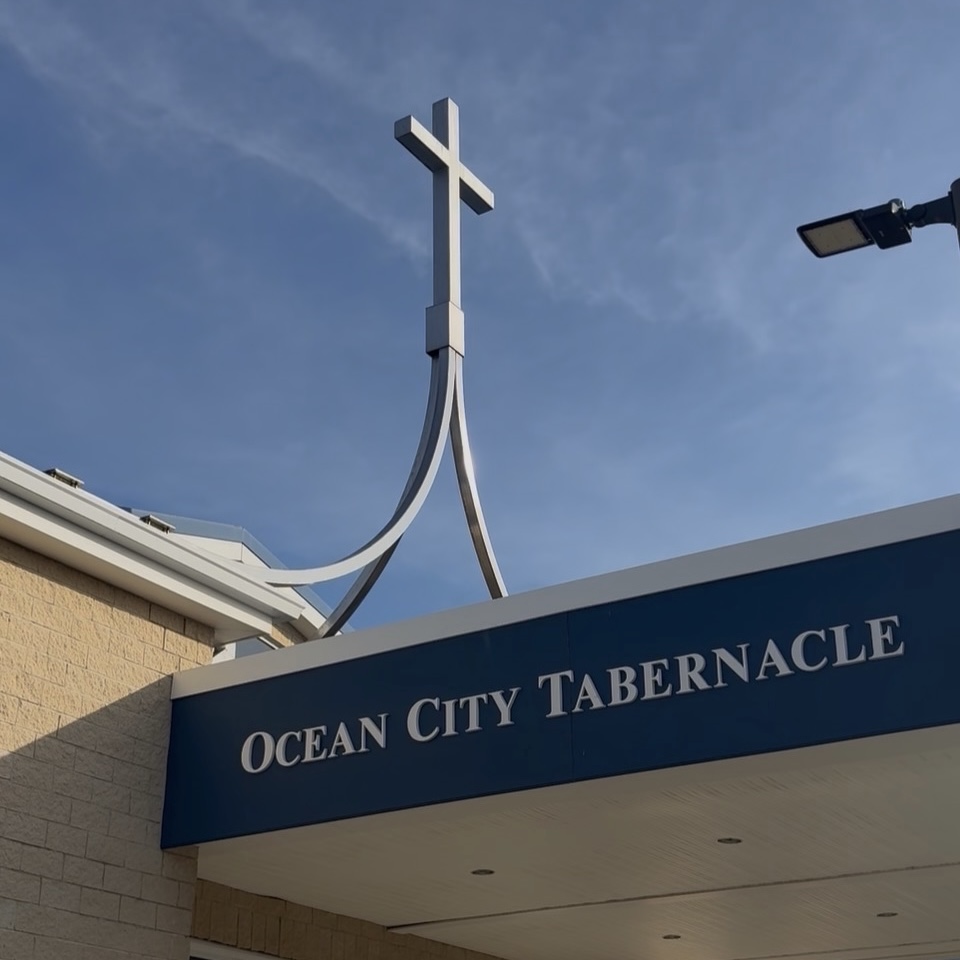
Our Immeasurable God
You Missed Something Extraordinary
There are messages that comfort you. And there are messages that correct your scale — that make the things looming largest in your life suddenly look the right size next to the God who holds the oceans in his palm.
Dr. Bryan Murawski — Old Testament professor at Cairn University and pastor at Riverstone Church in Yardley, PA — spent August 23rd at the Ocean City Tabernacle doing the second thing. His text was Isaiah 40:12-31. His goal was simple and stated plainly: “If you leave here talking not about how good the preacher was, but about how great and immeasurable our God is — I’ve done my job.”
He did his job. The full service is available on the Ocean City Tabernacle YouTube channel.
Who Is Dr. Bryan Murawski?
Dr. Bryan Murawski serves as Pastor of Ministry Development at Riverstone Church in Yardley, Pennsylvania, and as a professor at Cairn University, where he specializes in Old Testament theology. He earned his doctoral degree in Old Testament from Westminster Theological Seminary. He is, in the best sense, a teacher’s teacher — someone who has spent years training the next generation of preachers and pastors to handle the text of Scripture with rigor and clarity.
Tom Sherf knew him years before the pulpit — as a standout student when Tom was Resident Director at Cairn, a young man whose love for the Word showed up in Bible studies, academic papers presented to his hallmates, and a consistent commitment to the Lord that left an impression.
He arrived at the Tabernacle on August 23rd feeling, by his own honest admission, slightly intimidated by the speaker lineup he had found on the website. What he brought instead of a big name was something the summer series always needs in its final weeks: a master teacher, a great text, and a room full of people who needed to be reminded exactly how big their God is.
Isaiah 40 and the Storms On the Horizon
Isaiah was a prophet who served for nearly 60 years in Israel — through seasons of spiritual crisis and seasons of revival. By the time we reach chapter 40, the people of God have been receiving difficult news: Babylon was coming. A foreign empire would destroy their place of worship, kill thousands, and carry many into exile. A storm was brewing, and everyone knew it.
“I’m not sure what storms are brewing in your life right now,” Dr. Murawski said. “What’s over the horizon when you drive back across that bridge and go home? Maybe it’s financial pressure. Maybe it’s a personal health struggle. Maybe it’s a relationship. Maybe it’s all of the above — a perfect storm of difficulties. Sometimes when those things pile up, we find ourselves wondering, God, what are you doing?”
Isaiah’s answer was not to minimize the storm. His answer was to redirect the eyes of God’s people toward the immeasurable greatness of the God who stands behind it. “My desire this morning,” Dr. Murawski said, “is not to make my name known, but to make God’s name known. If you leave here talking not about how good the preacher was, but about how great and immeasurable our God is — I’ve done my job.”
“Stop looking at your problems as if they’re the biggest things in this world. They’re real. They’re difficult. But fix your eyes beyond them at the creator of this universe who died for you, who loves you.”
He Holds the Oceans in His Palm — Isaiah 40:12
Isaiah’s opening question in verse 12 is perfectly pitched for a room full of people who just spent the week looking at the Atlantic Ocean: “Who has measured the waters in the hollow of his hand?”
How much water is there on and under the earth? Dr. Murawski looked it up. “Something like 370 quintillion gallons,” he said. “I didn’t know what a quintillion was, so I Googled that, too. A quintillion is a million trillion. That’s a lot of zeros.” Scientists make educated estimates. No human has actually measured it. And yet, Isaiah says, God doesn’t just count every one of those million trillion gallons — he can hold them in the hollow of his hand.
“Who has marked off the heavens with a span?” Isaiah asks next. The observable edge of the universe, according to astronomers, is about 46 billion light years away in radius — and that’s only what we can see. But God doesn’t measure the universe in light years. He measures it with a span — the distance between your outstretched thumb and pinky.
“He’s so big. He’s so powerful. He’s so infinite that he measures it with just the simple span of his hand. That’s our God.”
And God weighs mountains on scales, Dr. Murawski added — the way a gold miner carefully weighs flakes of dust by fractions of an ounce after a full day’s work. Except God does it with every mountain, every hill, every grain of dust on earth.
“God cannot only count every one of those million trillion gallons in the world — he can hold those gallons in the palm of his hand. He measures the universe with the simple span of his hand. That’s our God.”
Who Gave God Advice? Nobody. — Isaiah 40:13–14
Moving to verses 13 and 14, Isaiah asks: who has measured the Spirit of the Lord? Who gave him counsel? Who taught him?
The word “measured” in verse 13 is the same Hebrew word as “marked off” in verse 12. Isaiah’s comparison is deliberate: just as no one can measure the universe, no one can measure the Holy Spirit. And if we can’t even measure the breath that comes from God’s mouth, how could we possibly give him advice?
“Did God ask for help when he created this world?” Dr. Murawski asked. “Did he look around and say, ‘I need someone to tell me what to do here’? You remember the COVID press conferences — the president almost never stood alone. There was a vice president, doctors, advisors surrounding him. If God were to do a press conference on how he made the world, you know who he’d have up there with him? Nobody. He didn’t need counsel. He didn’t need advice. This should humble us in our lack of knowledge.”
“We cannot measure the Holy Spirit. If we can’t even measure the breath that comes out of his mouth, how are we going to give him counsel? Who are we to give God advice?”
The Nations Are Less Than Nothing — Isaiah 40:15–17
Isaiah turns the lens from God’s wisdom to his power, and the comparison is staggering. “Behold, the nations are like a drop from a bucket… All the nations are as nothing before him. They are accounted by him as less than nothing and emptiness.”
Dr. Murawski illustrated with a chain of escalating power: a strongman competitor can bench press a car, but loses to an elephant. An elephant is overwhelmed by a volcanic eruption. A volcano’s blast is nothing compared to a single second of heat from the sun. “And all the power in this universe,” he said, “is like a drop of water from the bucket of the almighty God in comparison.”
He paused on verse 17’s language — nothing, less than nothing, emptiness — calling them “divine versions of playground insults. Do you remember first grade? You’re nothing. Yeah, well, you’re nothing minus one. You’re nothing minus infinity. That’s what Isaiah is doing.”
And then he named the application directly: “Nationalism can become idolatry. We can be proud that we are free. We can be thankful for those who bled for our freedom. We can celebrate the 4th of July. But at the end of the day, our hope is not found in this country. Our hope, our identity, our greatest love and our joy is being a child of God. And in comparison to the greatness of God, even America is less than nothing before him.”
“America is less than nothing before God. Europe is less than nothing before God. Our hope, our identity, our greatest love and our joy is being a child of God — not a citizen of any nation.”
The Gradual Creep of Idolatry — Isaiah 40:18–20
“To whom then will you liken God?” Isaiah asks — and answers with biting sarcasm. An idol. A craftsman casts it. A goldsmith overlays it. If you’re too poor for gold, someone will whittle you one out of wood.
Dr. Murawski pointed to the Hebrew verb structure of verses 18-20. A one-time completed action, then a participle of ongoing action, then a verb of continual future action. “What began as a singular act ends up becoming a habit of life. What started as a one-time thing becomes the way that we live. And isn’t that the way with idolatry? You don’t just wake up worshiping a piece of wood all of a sudden. It’s gradual. It’s a slow process that eventually brings you in and enslaves you.”
Then came the illustration that made the room go quiet: the smartphone. He traced the arc from wall-mounted phone to car phone to Nokia to Snake to the entire internet in your pocket. “Many of you sleep with it more closely than you sleep with your spouse. When it buzzes, you run to it. You give it life multiple times a day from a charger. And now you cannot live without it.”
“Why worship gods of wood and gold when we can worship the God who created wood and gold? Idols start slow. They creep in. They take over. And they will not be moved.”
“Why worship gods of wood and gold when we can worship the God who created wood and gold? Idols rarely start off by controlling our lives. They gradually creep into our hearts, take over, and will not be moved.”
God Knows Every Star by Name — Isaiah 40:25–26
Verse 25 introduces a shift — God himself speaks. “To whom then will you compare me, that I should be like him? says the Holy One. Lift up your eyes on high and see who created these. He who brings out their host by number, calling them all by name.”
How many stars? Dr. Murawski went back to Google. Astronomers estimate about two trillion galaxies in the visible universe, each with roughly 100 billion stars. Do the math and you arrive at a number with 23 zeros — more than a quintillion.
“And Isaiah says God created every one of them and has a name for every one of them. You know how I know how remarkable that is? Parents, you can’t even call your kids by the right name half the time.” He told a story about his daughter asking, while watching Cheaper by the Dozen, how the dad remembered all twelve names — pointing out that their own mom calls them by the dog’s name when she’s mad.
“God knows the name of every star in this universe. We can’t even wrap our minds around the bigness of that statement. Who is there like our God? With whom can we compare him? No one.”
“God created every one of the two billion trillion stars in the visible universe — and has a name for every one of them. Who is there like our God? With whom can we compare him? No one.”
How Can You Say God Has Forgotten You? — Isaiah 40:27
After spending fifteen verses establishing the immeasurable greatness of God, Isaiah turns to the very human complaint in verse 27: “Why do you say, O Jacob, and speak, O Israel, ‘My way is hidden from the Lord, and my right is disregarded by my God’?”
The juxtaposition is the entire point of the chapter. “You now know who this God is,” Dr. Murawski said. “You have a glimpse of the bigness of your God. And now that you’ve been given this glimpse of his enormity — how can you turn around and say, ‘God doesn’t notice me’? How can you say God is ignoring me when God knows trillions of stars by name?”
“When we complain about God, we are standing in place of God and saying, ‘God, my righteousness and my wisdom and my power are better than yours. You should have done it my way.’ There is not a man or woman on earth who can search the mind of God and understand all his ways. There is no human court that can declare him guilty. There is no other God to challenge him.”
“God who knows the names of two billion trillion stars — surely he sees the troubles of each and every person in this room.”
“How can you say God is ignoring you when God knows every star by name? When we complain about God, we are standing in his place and saying his wisdom and power should be replaced by ours.”
Three Truths — and What It Actually Means to Wait — Isaiah 40:28–31
The chapter’s famous closing verses — “they who wait for the Lord shall renew their strength, they shall mount up with wings like eagles” — carry three truths, Dr. Murawski said, that have to be held together to be understood.
First: God is all-powerful and always will be. He is everlasting, the creator of the ends of the earth. He does not faint or grow weary. There is no limit to his knowledge or wisdom and he does not turn it off.
Second: you are not. “I know you don’t like to hear that, but it’s true. We are weak. Even young people get tired. I have four kids. They do not stop moving from the moment they get up until they go to bed at night — but they do go to bed at night.”
Third: God gives strength to those who wait for him. But what does it mean to wait? Dr. Murawski described a church visit early in his marriage where a countdown timer on the screen ticked from ten seconds to zero, then lit up with “Waiting Complete.” “One of the dumbest things I’ve ever seen in a church service in my entire life. But to be honest, I’m not sure many Christians know much more about what it means to wait on God.”
Biblical waiting, he said, is not passive. It is “a hopeful expectation for God to fulfill the promises of his word — not ‘I hope it will happen’ but ‘I know it’s coming and I can’t wait for God to do what he promised.’” He illustrated it with getting up before sunrise to watch the dawn that morning with his wife. It was cloudy. They couldn’t see the sun. But morning still came. “You know for sure God is going to do the things he said he’s going to do. That’s what it’s like to wait on God.”
“Waiting on God is a hopeful expectation for God to fulfill the promises of his word. Not “I hope it will happen.” But “I know it’s coming and I can’t wait for God to do what he promised he will do.””
A Closing Word — The Biggest God, the Deepest Love
Dr. Murawski closed with the move that made everything before it land: he turned from the immeasurable greatness of God to what that God did.
“That God — the God that we just saw — when you go to the New Testament and John starts his gospel by saying ‘the Word became flesh and dwelt among us,’ God humbled himself to become human, to live a perfect life, to die on the cross for your sins, to rise again three days later because he loves you. That is love. The bigness of this God loving you in that way.”
“I don’t know what kind of baggage you carried with you over that bridge to get here. But I know we all got something. And I know we’re all going home to something. Fix your eyes beyond your problems at the creator of this universe who died for you, who loves you. God is big. God is faithful. And God loves you.”
The full service is available now on the Ocean City Tabernacle YouTube channel. Share it with someone whose problems are feeling bigger than their God right now.
Watch the Full Service — Ocean City Tabernacle on YouTube
If you missed Dr. Murawski’s message in person, the full service is available now on the Ocean City Tabernacle’s official YouTube channel. Watch it, share it, and come back next Sunday.
Watch Dr. Bryan Murawski: “Our Immeasurable God” — youtube.com/live/br01sBlcMFs
Subscribe — new messages all summer long: youtube.com/@OceanCityTabernacle
Ocean City Tabernacle • 550 Wesley Ave, Ocean City, NJ 08226 • octabernacle.org
A family ministry center where the Gospel of Jesus Christ is central — every Sunday, all summer long.
Partner With Us
Each season, the Tabernacle becomes a place where people gather to hear the Word of God, worship together, and be renewed in their faith. Your support helps make that possible—strengthening a ministry that proclaims the Gospel, invests in the next generation, and provides a place where residents and visitors alike can encounter truth, encouragement, and community. By partnering with the Tabernacle, you are helping ensure that this work continues with clarity, purpose, and lasting impact.